
I’ve always been intrigued and admired the skill of actors treading the boards of a stage and their ability to remember their lines.
It’s not just that. It’s committing to the script with the nuance and intensity required for us, the great unwashed, to interpret what they’re saying and believe in the characters.
It is why a good play can be so engaging, that sense of anticipation and edginess hoping the players don’t stuff it up because there is no second chance.
So imagine performing three separate plays in one day!
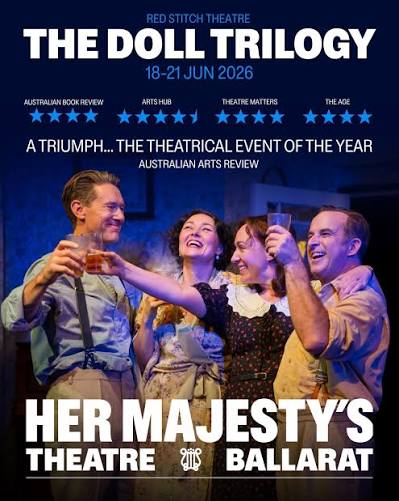
Melbourne’s Red Stitch Theatre have boldly just done that, and have taken this extraordinary production to Australia’s two oldest theatres, The Theatre Royal in Hobart and Her Majesty’s in Ballarat.
We were fortunate to see the three plays that make up The Summer Of The Seventeenth Doll last Saturday in Ballarat, alongside hundreds of visiting theatre lovers.
There were two options for viewing the shows. You could see Part One on Thursday night, Part Two on Friday night and Part Three on Sunday afternoon, or see all three on Saturday. We chose the latter in what would be a unique experience.
I first saw a Melbourne Theatre Company production of TSOSD thirty years ago and had no idea that the play was the last of a trilogy.
All three plays are full length and approximately an hour and a half each, so on Saturday there were hundreds of ‘middle agers’ and a spattering of university arts students spilling out into Ballarat’s eateries during the hour long breaks between plays.
Ray Lawler’s classic trilogy was written in 1955. Set permanently in a Carlton boarding house, Part One called Kid Stakes takes us into the depression times of 1937. Part Two called Other Times, is set at the end of WW2 in 1945 and the final play The Summer of The Seventeenth Doll is set in 1953.
Roo and Barney are cane cutters from Qld who have a relationship with Olive and Nancy that runs across the three plays.
Olive’s mother Emma owns the boarding house and next door is a young girl Bubba whose presence increases with time.
There are a few other characters but ultimately there are only seven characters in total so one of the actors ‘doubles’ up and another ‘triples’ up, both so seamlesly it was hard to pick it.
The two Queenslanders work seven months of the year then spend five months in Melbourne staying at the boarding house with the girls.
The entire story is like a giant chocolate cake full of lively ingredients. It examines many topics that are amazingly so relevant to Australia of today, which is why it has maintained its charm and curiosity.
Sexual politics, misogyny, feminism, alcoholism, domestic violence, poverty, war, blind optimism, dry humour, fragility of dreams, challenging stereotypes, mateship and plenty more topics are there to discuss over a feed.
The secret to Lawler’s writing is in its subtlety. SOTSD doesn’t throw any of the aforementioned messages in your face.
It’s a cake that mixes all the narratives with finesse, keeping all the threads in-tact without any profanity.
That doesn’t mean a soft delivery. Simply all the dramatic parts are highly explosive without dropping the ‘F bomb’. It’s also a highly authentic piece of Australian history.
The dialogue and accents are superb and capture a much simpler time without the technology of today.
A massive hats off to Red Stitch and their awesome actors for executing what felt like the thespian equivalent of a runner’s sub-three hour marathon.


Great content! Keep up the good work!